
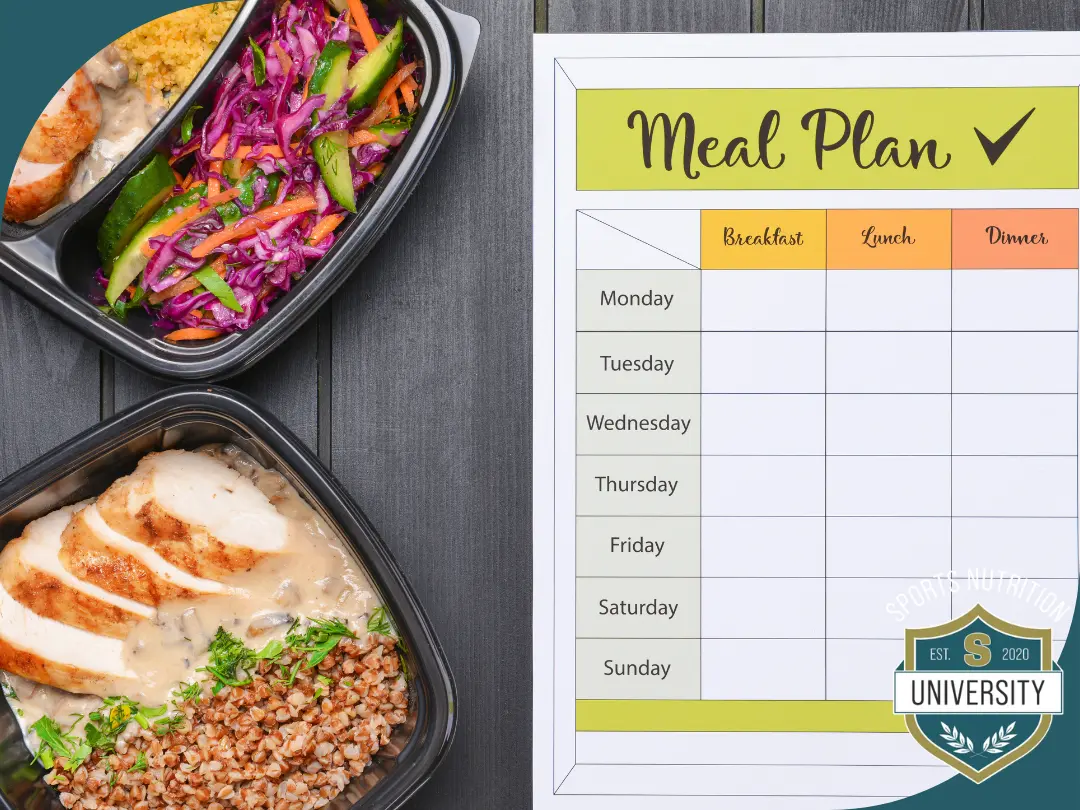
So, SO many athletes, their parents, and coaches ask me about meal planning when they come to me for help.
And while they think a meal plan is the answer to their prayers, in reality, it simply handicaps the athlete.
That’s because you pay $$$ for this “meal plan.” You hand it to your teenage athlete and they follow it for a day.
On day 2, it’s crumpled at the bottom of their gym bag, and they give up following the meal plan.
This leads to $$$ down the drain, the athlete isn’t helped, and parents/coaches/athletes feel stuck, frustrated and WORRIED.
Worried that they’ll never figure out the knowledge they need to improve performance with nutrition.

What Does Meal Planning Look Like for Teen Athletes?
Let me start by saying this … When I help athletes, I work with this quote as my foundation: “If you give a man a fish, he eats for a day. But, if you TEACH a man to fish, he eats for a lifetime.”
Meal plans are not inherently bad, but they provide false hope.
False hope that if it’s followed perfectly, it leads to success.
But, what if the athlete is going from eating JUST TWO MEALS per day and the meal plan has THREE MEALS + 3 SNACKS … Do you think that’s a realistic progression?
I think maybe the athlete could do that for a day, but it’s going to be overwhelming to keep it up.
That’s because the athlete didn’t learn:
- Planning skills
- Organization skills
- Cooking skills
- How to progressively increase their calories
But, it’s not their fault!
They were given a meal plan that sounded like the perfect solution!
“Fuel Planning” with a Registered Dietitian and Sports Nutrition Coach
So, when I work with an athlete, I help THEM meal plan.
But we call it a “fuel plan”.
In my teen athlete coaching program, we talk about fuel plans ALL. THE. TIME.
That’s because without it, all your new knowledge and skills will crumble.
A fuel plan provides the foundation to be successful and we create these inside my program.
Adopting a fuel plan instead of traditional meal planning empowers teen athletes to take charge of their nutrition in a way that supports their athletic performance and fosters lifelong healthy habits.
By focusing on nutrient-dense foods, timing meals around training, and building flexibility into their eating routines, young athletes develop the skills to make informed food choices that enhance energy, recovery, and overall well-being.
This approach not only fuels their current performance but also equips them with the knowledge and confidence to sustain their athletic journey for years to come.
Want to learn more? Reach out to me today!