
Transitioning from high school elite sports to the collegiate level is one of the most exciting milestones in an athlete’s career. However, it comes with a major shock to the system: losing the luxury of home-cooked meals. For years, your parents or guardians may have structured family dinners around your heavy training blocks, ensuring you had optimal ratios of clean proteins, complex carbohydrates, and healthy fats.
Suddenly, you are dropped into a 12×12 dorm room with nothing but a mini-fridge, a microwave, and a grueling schedule of morning lifts, team meetings, classes, and late-night practices. Relying solely on standard campus dining hall food can lead to performance slumps, unwanted body composition shifts, and delayed recovery.
Optimizing nutrition for college athletes doesn’t require a commercial kitchen—it just requires strategy. With the right blueprint, your microwave and mini-fridge can become your ultimate high-performance fueling station.

The Reality Check: Why Dorm Nutrition Dictates Performance for College Athletes
At the collegiate level, the margin between winning and losing, or starting and sitting on the bench, is razor-thin. Your training volume will double, and your cognitive load will skyrocket. If your nutritional intake drops, you introduce a massive risk of under-fueling, muscle wasting, chronic fatigue, and bone stress injuries.
Failing to plan your dorm nutrition leads directly to the “dorm food trap”—relying on processed instant noodles, sugary cereals, and late-night fast food runs. To maintain explosive power, endurance, and mental clarity, you must learn to navigate your micro-kitchen with tactical precision.
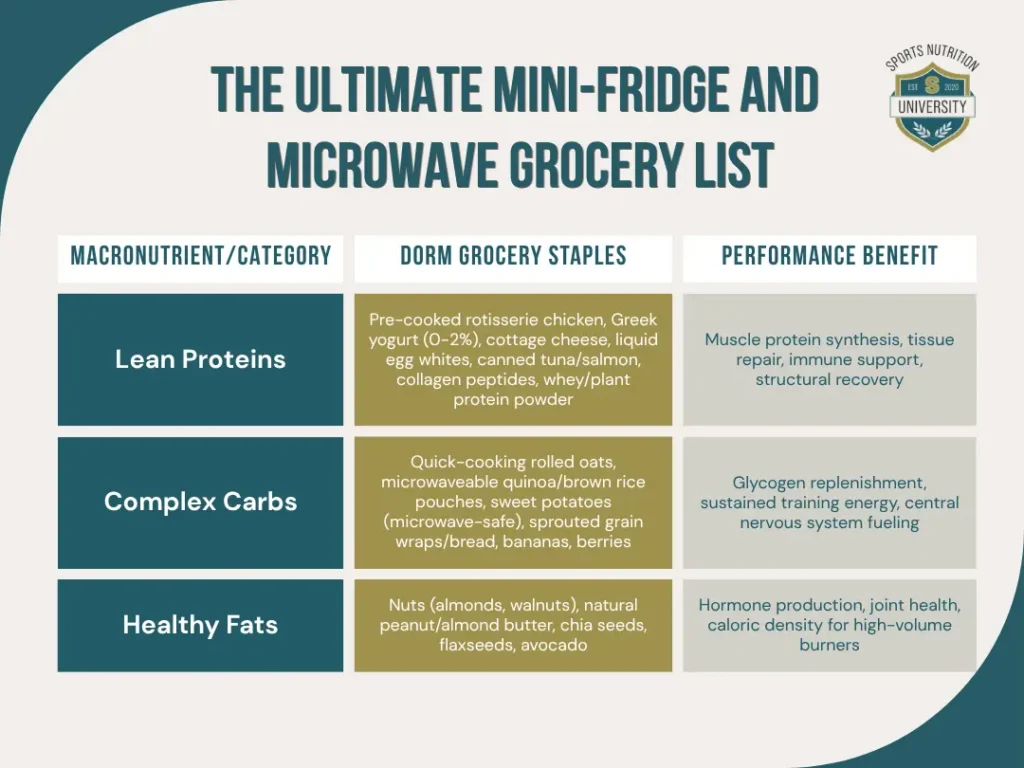
The Ultimate Mini-Fridge & Microwave Grocery List: Performance Nutrition for College Athletes
To succeed, you must treat your grocery shopping like a scouting report. Every item taking up valuable real estate in your mini-fridge or micro-pantry must serve a performance purpose. Focus on dense, high-yield macro sources that require zero traditional cooking.
Learn more: The Ultimate Guide to Creating a Grocery Shopping List
3 Dorm Room Hacks to Maximize Small Spaces
- Zoning the Mini-Fridge: Mini-fridges often have uneven temperature distribution. Keep dairy, meat, and liquid egg whites near the back/bottom where it’s coldest to prevent spoilage. Keep fruits and vegetables in the door or front.
- The Steam-Bag Advantage: Frozen vegetables in microwaveable steam-bags are a game-changer. They retain their micronutrients perfectly and cook in 3 minutes, giving you instant access to polyphenols and fiber without chopping or boiling.
- Stackable Prep Containers: Space is tight. Buy a set of glass or BPA-free stackable containers to store rotisserie chicken, overnight oats, or sliced fruit efficiently.
The Protein Window Secret: College athletes need a consistent drip of amino acids throughout the day to maximize recovery. Aim for 25–40 grams of high-quality protein every 3 to 4 hours. Do not depend on the dining hall operating hours to hit these windows; use your dorm staples instead!
Learn more: Protein for Teen Athletes: A Guide to Optimal Nutrition
5-Minute High-Performance, Nutritious Recipes for College Athletes That Can Be Made in a Dorm Room
Here are five quick, macro-balanced meals built entirely around a microwave, a mini-fridge, and fundamental nutrition for college athletes.
1. Powerhouse Microwave Oatmeal Bowl with Collagen
- Best For: Pre-workout fuel or quick breakfast
- Ingredients: ½ cup quick oats, 1 cup water or almond milk, 1 scoop collagen peptides, 1 tbsp peanut butter, 1 sliced banana
- How-To: Microwave oats and liquid for 90 seconds. Immediately stir in the collagen peptides (it dissolves seamlessly in hot liquids without altering texture). Top with peanut butter and banana slices for a perfect blend of slow-burning carbs, joint-supporting amino acids, and healthy fats.
2. Rotisserie Chicken & Avocado Wrap
- Best For: Post-workout recovery or quick lunch
- Ingredients: 1 large sprouted grain wrap, 5oz shredded rotisserie chicken, ¼ mashed avocado, handful of baby spinach, 1 tbsp hummus
- How-To: Lay the wrap flat, spread the hummus and mashed avocado across the center. Layer the spinach and chicken. Roll tightly. This provides massive protein density and healthy fats to fight inflammation without a single second of cooking.
3. High-Protein Overnight No-Cook Oats
- Best For: Early morning training fuel
- Ingredients: ½ cup rolled oats, ¾ cup skim milk or soy milk, ½ cup plain Greek yogurt, 1 tbsp chia seeds, handful of berries
- How-To: Mix all ingredients in a jar or container the night before and place in the mini-fridge. By 6:00 AM, the oats will be soft and packed with dual-source protein (whey/casein from yogurt and milk) to sustain your energy through tough morning lifts.
4. Savory Microwave Rice & Egg White Power Bowl
- Best For: Dense evening dinner
- Ingredients: 1 pre-cooked brown rice/quinoa pouch, ½ cup liquid egg whites, ½ cup frozen mixed veggies, splash of low-sodium soy sauce
- How-To: Microwave the rice pouch for 90 seconds. Pour half into a microwave-safe bowl, stir in the liquid egg whites and frozen veggies. Microwave for another 60–90 seconds, stirring halfway through until the egg whites are fully cooked and fluffy. Drizzle with soy sauce.
5. Nutritious Midnight Parfait
- Best For: Sleep recovery & muscle preservation
- Ingredients: 1 cup 0% or 2% Greek yogurt or cottage cheese, 1 tbsp walnuts, ½ cup berries, drizzle of honey
- How-To: Layer the dairy with berries and walnuts in a cup. Cottage cheese and Greek yogurt are loaded with casein protein, a slow-digesting protein that repairs muscle tissues while you sleep, preventing overnight muscle catabolism.
How College Athletes Can Master Their Nutrition During the High-School-to-College Transition
Navigating the athletic jump to college is complex. Your body is undergoing unprecedented physical stress, and trying to handle your fueling protocols through guesswork can hinder your trajectory. No blog post can replace one-on-one coaching and tailored periodized nutrition matching your specific sport and position requirements.
The transition from a home-cooked meal environment to independent college life is the exact point where many incredible athletic careers stall out due to poor nutrition. But that’s where working with a dedicated Sports Nutrition Coach and Registered Dietitian plays a significant role in your overall success. At Sports Nutrition University, we’re your ultimate go-to resource for the high-school-to-college transition. Together, we can craft a personalized, hyper-practical plan built around your exact living arrangements, training schedule, and performance metrics so you can dominate from day one.
Ready to get started or want to learn more? Consult with a sports nutrition expert at SNU today!